RAE’S READS

  • I took a summer course on the essay during my graduate school work, studying Montagaine, Rousseau, Emerson, and the classic essayists, but it was not until the past ten years that I have come to appreciate contemporary essays. I have reviewed here before essay collections by Anne Lamott, Anna Quindlen, and Pat Conroy.

    Last night I finished a lovely collection of essays,

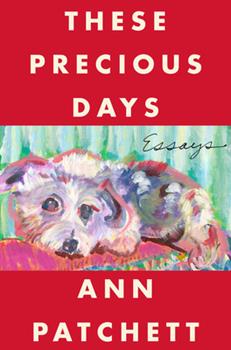
    Precious Days by Ann Patchett was a wonderful collection of timely essays.

    I have read both Commonwealth and The Dutch House, two of Patchett’s NY Times bestsellers, so I had been exposed to her expertise as a novelist. Imagine my great pleasure to discover she is equally adept as an essayist. This large print edition’s cover, published in 2009 caught my eye at the local library. I took it home, and put it on my bedside shelf. The painting of the dog, with its post-impressionistic connotations, made me curious about the artist, whom was written about in the title essay, ” These Precious Days.” Had it been a short story, I would argue it was a novelette, judging from its length. However, it is non-fiction, reflecting a true experience of the author; so instead, it is a very long essay.

    “Precious Days” chronicles the author’s friendship with a publicist/assistant of Tom Hanks named Sookie, who came to live with Patchett and her husband as she took on exhausting cancer treatments at a hospital in their town. The friendship that grew between the two women, actually, the three adults, was nothing short of amazing. And anyone would have liked to become a friend of the creative, courageous, paragon of a positive attitude as was Sookie. I was so relieved that Sookie was alive at the end of the essay (although her death date is given in the Epilogue) that I wanted to shout, “Way to go, girl!”

    My second two favorites were “Eudora Welty, an Introduction” written for The Collected Stories of Eudora Welty, published in 1980, when Welty was 71. Interestingly enough, Patchett had met Welty as a young girl at a reading, at which Welty signed one of her books for her precocious reader, Patchett.

    I also enjoyed “There Are No Children Here,” which recounts how Patchett appeared on the same platform as a fellow, unnamed author who contended that until one had children, they’d never experienced love. Because I wanted to be a teacher more than I wanted to be a mother, and felt I couldn’t do both and do them well, I chose not to have children, so, of course, I cheered Patchett on when she disagreed and said, ” …I have to tell you, people without children have known love , and we are [real] writers.” I couldn’t agree more.

    This particular book of essays was nice for “picking up and putting down,” sporadic reading. I found myself reading an essay or two, then devouring a whole novel, or watching episodes of Netflix series in between essays. The structure of this collection was conducive to this, and it made for a variety of reading sessions for the four weeks I kept it from circulating at the library. It is a fine collection of literary essays by a fine writer, one of my new favorites–Ann Patchett.
  • Thanks to Reading Reality for the use of their meme.

    This past week saw many new additions to my bookshelves:

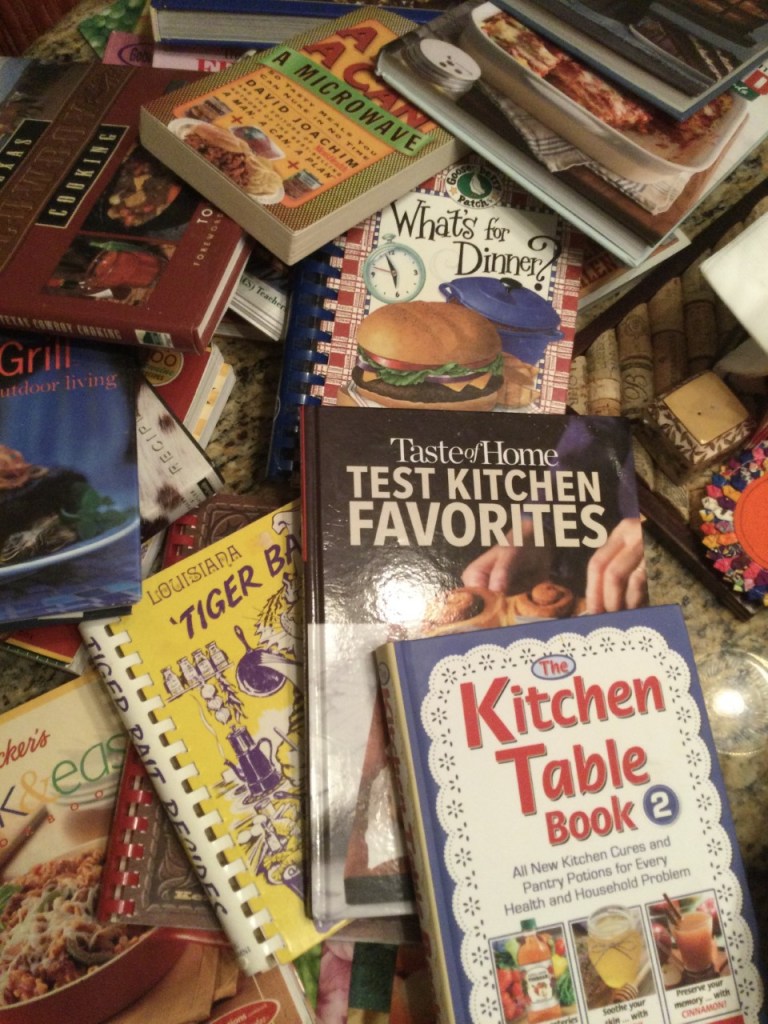
    A friend gave me a box of cookbooks as she was doing away with “clutter.” Her clutter, my treasures.

    Some of these were put on the shelves of books destined for my bookstore, some went into my Little Free Library and other LFLs in Alvin, and three were saved for a friend who reads cookbooks like I read novels.

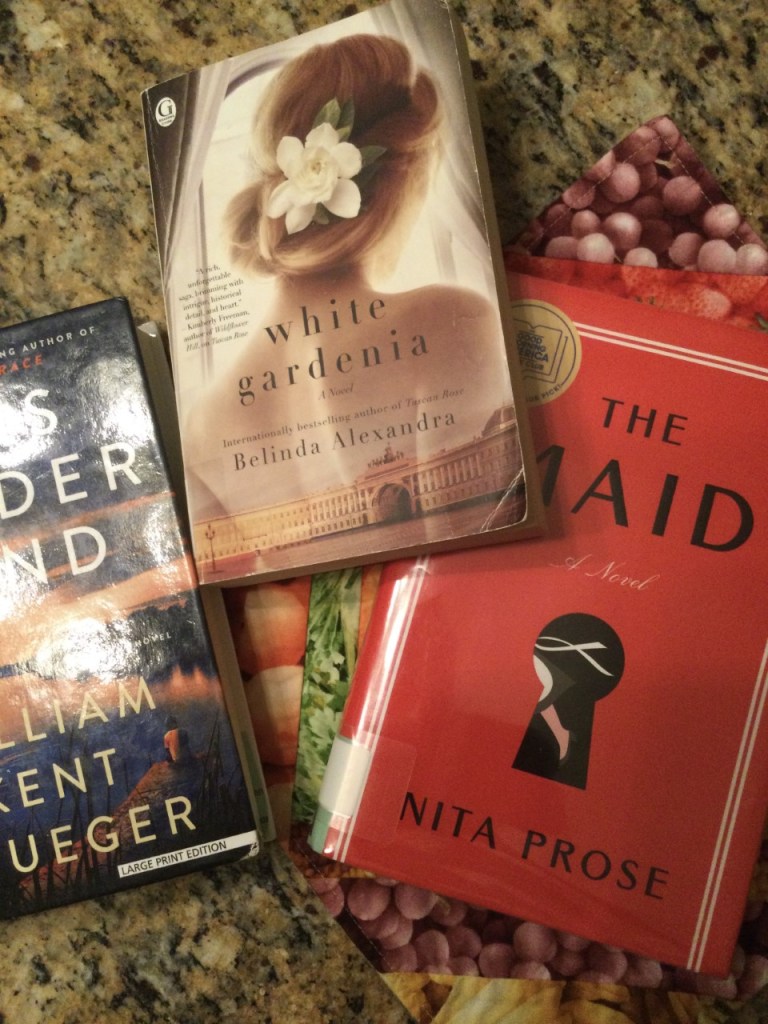
    These three were my “holds” that arrived at the Alvin Library this week. I have begun The Maid, this month’s selection for my Third Tuesday book club.

    I am really looking forward to the latest Krueger novel. His Saving Grace was a wonderful read. The fact that it was available in Large Print was a plus.

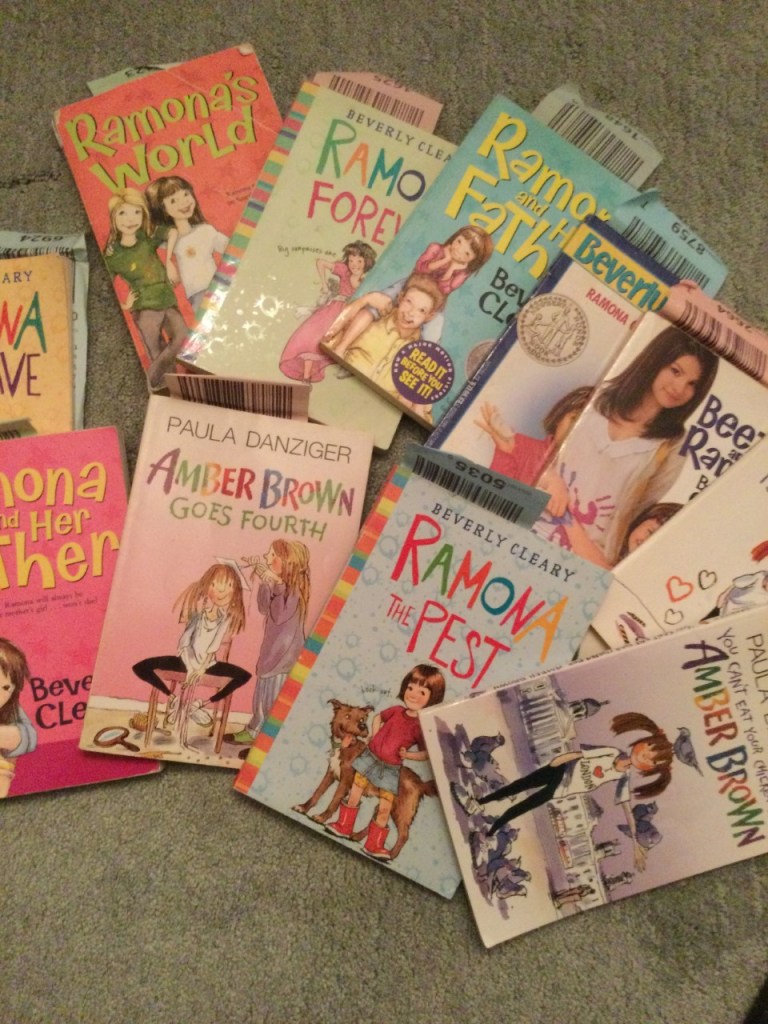
    I ordered these for my bookstore. The shelves are filling up.

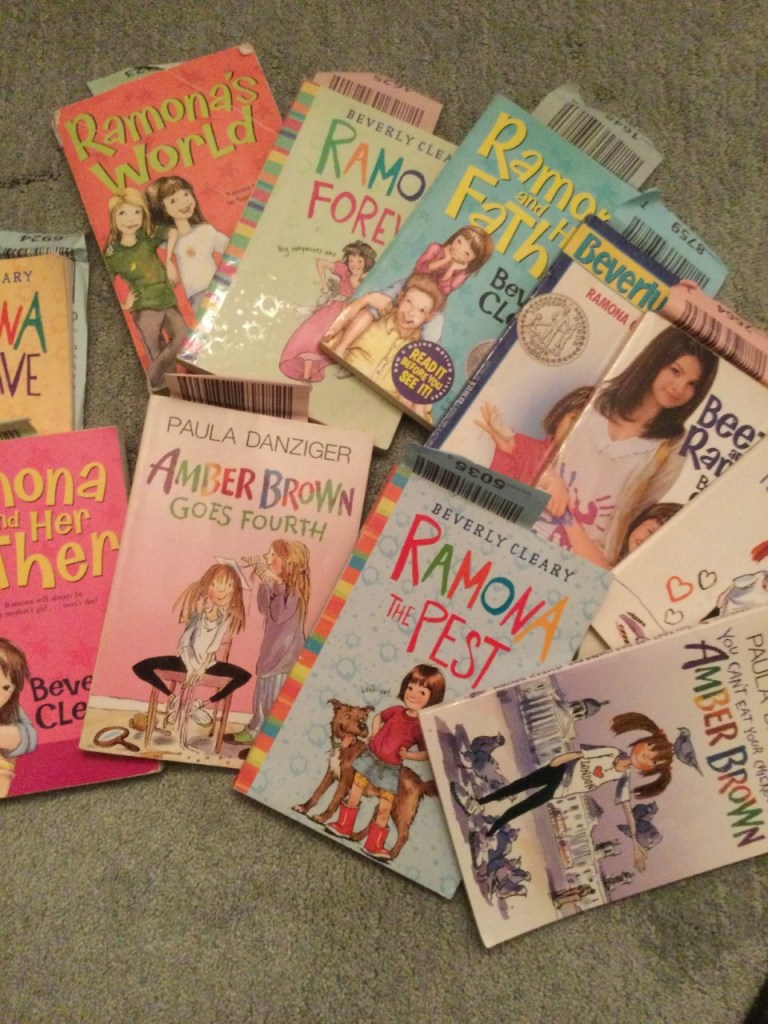
    Ramona was one of my favorite series as a kid. I think I read ALL the books. Amber Brown series is one I discovered as an adult, thanks to a donation to my Little Free Library.

    I am certainly set for some good reading and am further down the road toward establishing my bookstore inventory. Hmmmmm, maybe it’s time for another Readathon!

    Labor Day weekend would be the perfect time for a little personal Readathon.

    HAPPY READING! What did you add to your shelves this week? Post on your blog or tell me in the reply/comments area below.

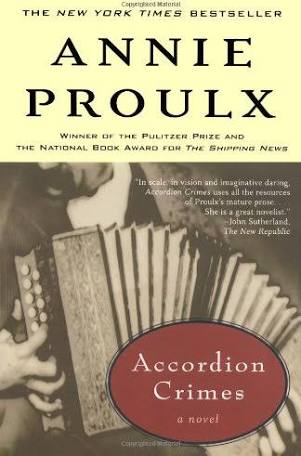
  • The Shipping News was one of my favorite books–ever. This novel, Accordion Crimes

    by the same author was not as engaging but a darned good read in its own right. The metaphor or theme was pure genius: a small green accordion which was passed from owner to owner over the decades, and character sketches of its various owners.

    Written in 1996, the novel has been called by critics, “a masterpiece of storytelling.” It begins in 1890s’ Sicily, where the accordion maker fashions the small, elegant accordion. He and his son immigrate to America with dreams of opening a music store. They come to live in New Orleans, and when the accordion maker is murdered, the green accordion falls into the hands of someone who carried it onward to Iowa, then to Texas.

    The music of the accordion is the “last link to their pasts ” for Mexicans, Africans, Poles, Germans, Norwegians, Irish, Basques, and Franco Canadians, as the instrument moves from owner to owner, family to family. It “becomes their voice[s] for their fantasies, sorrows, and exuberance[s],” all of which Proulx shares with the reader. The novel introduces many, many characters, each a representative of their ethnicity as the accordion travels across the continent and back. There is a surprise ending, which brings the reader’s memory all the way back to a forgotten event/detail. This novel is a darned good read.

  • SATURDAYS ARE RESERVED FOR REVIEWING KIDS’ BOOKS ON PWR.

    REMEMBER the Ramona books by Beverly Cleary? They’re back; actually, they never went away, just the same homespun wisdom and humor with new covers. I think I read all the Ramona books, but it was only as an adult I discovered Amber Brown. Those too are great books for kids. If your kids or grandkids are into chapter books and series, I highly recommend these two series as something they will really love.

    Thanks, Evin, for the sign off.
  • Thanks to Deb Nance of Readerbuzz for the loan of this fine birthday meme.

    Here are the questions from Classic Club’s questionnaire:

    1. When did you join The Classics Club? late 2019 after seeing the club on Readerbuzz.
    2. What is the best classic book you’ve read so far? I liked most of them, so it’s hard to pick the BEST, but maybe Brideshead Revisited.
    3. What is the first classic book you read? Lord Jim
    4. What classic book inspired you most? The Secret Garden
    5. What was your most challenging classic? Don Quixote, I’d been trying to read it since high school
    6. What was your favorite movie adaption? I Capture the Castle, but Bridesead Revisited was well done too
    7. Which classic character reminds you of yourself? The ditsy mother in I Capture the Castle…I like to think I’m creative and a free spirit, but sometimes it’s just being scatterbrained
    8. Has there been a title you expected to dislike but ended up liking? Don Quixote
    9. What is one classic you definitely will make happen next year? I don’t know. Recently there have been enough classics “required” as book club selections or challenge books, but I may have to go back to drawing from a jar or using a spinner.
    10. What are some of the fond memories you’ve had of the classics club? Mainly it gave me a good feeling of completing a list given me during my junior year in high school titled, “Outstanding Fiction for College Bound Students, “but then it’s always fun to compare notes on Classics Club with close friend Deb Nance.

    I hope you enjoyed reading the answers to these questions as much as I enjoyed answering them. Even if you do not “belong to the club,” you can reply to the reading the classic questions on your blog or in the reply box below.

    CLASSICS COUNT!

    Rae

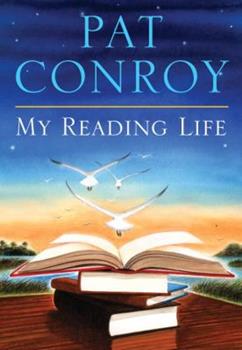
  • I have enjoyed several books by Pat Conroy, best known for The Great Santini. His 2010 publication, My Reading Life introduced me to him as an essayist, and a good one at that.

    An interesting wide-spanned topic inclusive book of essays.

    Actually Conroy’s book is a collection of tributes to authors and books that helped form him as an author and as a man. His brutal father, depicted in The Great Santini, and the influence of his genteel, book-loving reader of a mother are evident in many of the essays about his childhood and early-college literary leanings. As a young boy, Conroy was a voracious reader, reading far beyond his chronological age. His books were selected for him by his mother, and often they would read and then discuss the same books. This book is “an array of wonderful and often surprising anecdotes, ” covering the author’s early “love affair with the local library ” through his great success as a contemporary man of letters. The book is written for those “who believe in the power of books to shape a life” and captivates the interest and attention of anyone who loves books, libraries, authors and other things “bookish.”

    From his essay, “Why I Write:”

    “Good writing is the hardest form of thinking. It involves the agony of turning profoundly difficult thoughts into lucid form, then forcing them into the tight-fitting uniform of language, making them visible and clear.” I will definitely expose my Advanced Writing students to this concept in the coming semester. Conroy’s mastery of word choice and magnificent turn of phrase are transferred from his novels to his collection of essays in this small book. It is a satisfying read.

    Thanks Evin for the sign offs.
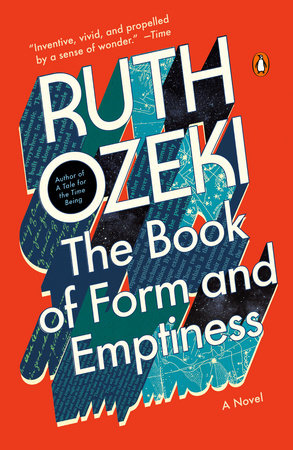
  • Ruth Ozeki’s The Book of Form and Emptiness was a real challenge to read.

    A “different” book

    To begin with, the narrator of this novel is a Book. Yes, you read that right, a book; a story, the story of Benny Oh, a young boy who hears the voice of the Book, his story. His mother Annabelle, is never the same after the death of Benny’s father, who is killed in a grotesque accident–meaningless and bizarre. In the novel she becomes a recluse and a hoarder. Benny takes “refuge [from his strange life] in the silence of a large public library.”He meets a homeless, wheelchair-bound philosopher and poet and a mesmerizing young woman, both classified as imaginary friends by the psychiatrist who takes on Benny’s case, but who turn out to be real people he met at the library. (Even the reader comes to doubt Benny for one awful moment–I did.)

    There is a run in with CPS, incarceration in a mental hospital for Benny, and a job loss for Annabelle. All of these semi-unrelated events come together in an implausible but satisfying ending. The novel is at times humorous, and at times heartbreaking . Above all, the book is difficult to read, and I am still trying to decide whether sticking with it was worth the huge effort.

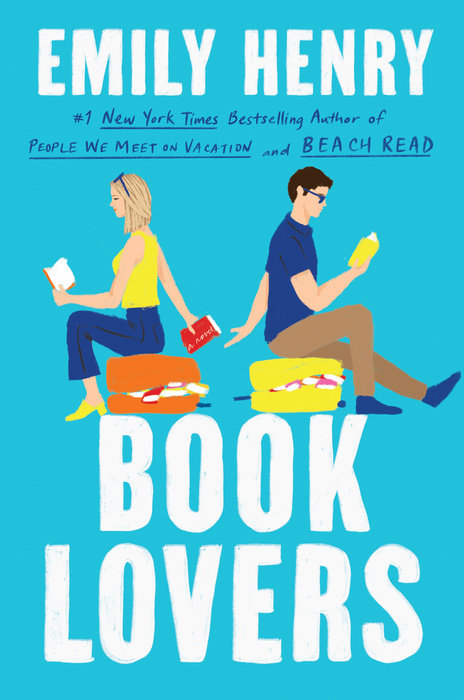
  • A 2022 publication that deals with the publishing industry

    Nora Stephens, an agent who almost always gets the best deals for her clients has been dumped at the beginning of the story. She misses her mother, who has died and feels responsible for her younger sister, Libby, but lives a driven life as a career woman. She meets Charlie, a hot-shot editor, for lunch only to be told he doesn’t want anything to do with her client’s latest effort. Their relationship develops along the lines of “a small-town love story” with “all the familiar tropes–” “hot-shot from NY or LA gets shipped off to Small town USA–to, like, run a family [owned business].” This outsider falls for a small-town farm/business “person who has true values and stays forever” on account of him/her.

    The Nora-Charlie plot follows the “plot” of a fictional novel, Once in a Lifetime, which Nora is promoting and Charlie is forced by his publishing house to edit. Nora thinks to herself early on, “Charlie doesn’t want to work with me, and I don’t want” to work with him. Their relationship begins as a dislike and builds almost to hate category, all the while feeling a strong physical attraction which neither wants to admit. This makes for humorous miscommunications and misunderstandings. In this instance, both protagonists are Big City people, thrown together in tiny Sunshine Falls. A second love interest for Nora, Shepherd, a farmer with a heart of gold turns out to be Charlie’s cousin, which further complicates matters.

    As you can tell, there are frequent twists and turns which all the while are underscored with a strong passion that torments both parties afflicted.

    It is a modern romance complete with likable/unlikeable main characters and interesting secondary characters who fill out the novel’s cast. I checked this book out of my local library after reading a lot of positive reviews about it. I was only slightly disappointed.

  • Adam’s Ale

    Deepthy's avatarRandom Specific Thoughts

    They both listened silently to the water, which to them was not just water, but the voice of life, the voice of Being, the voice of perpetual Becoming.
    ― Hermann Hesse, Siddhartha

    Hoarse visions and misty revolutions –
    Shrivelled, turbid and warm,
    Drip down civilization’s neck,
    Littering mausoleums
    Of forgotten gold and silver.

    Cruelty sweet and apathy sour,
    Flow out of these
    Crusty cracks and ivory paths
    Handcrafted to perfection, so
    They may yield the curves of withered lives.

    Placid as a water mirror
    And sharp as forgotten promises,
    These breaths of old,
    Scatter the winds
    To whispered worlds of tranquillity.

    Fallen at the altar of apathy,
    Souls depart in search
    Of emerald worlds,
    Hoping refuge is safeguarded
    By beings who emulate Adam’s ale.

    (featured image from Openverse – Water carvings in Africa)

    Be like water making its way through cracks. Do not be assertive, but adjust to…

    View original post 283 more words

  • Just as Saturday mornings were reserved for kids’ cartoons on 50s and 60s TV programming, PWR reserves Saturday Mornings for reviews of kids’ books. Today’s recommendation was previously used for a First Line Fridays’ post.

    Thanks” Reading Is My Superpower” host for loaning the image.

    Today’s book is the awaited sequel to…

    …by my favorite children’s author…

    Alda B. Dobbs

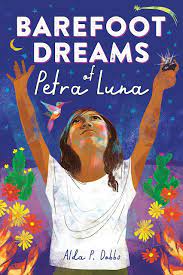
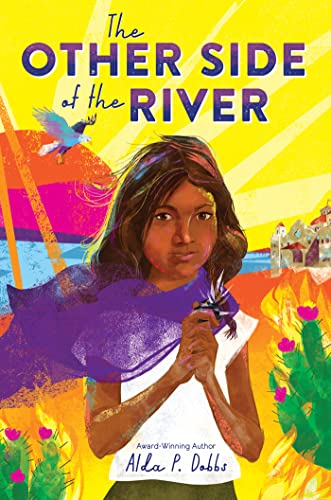
    As noted in the “Friday Firstliners”post, The Other Side of the River begins minutes after The Barefoot Dreams of Petra Luna leaves off. Barefoot Dreams ended with a cliffhanger, and now that River is coming out September 2nd, we can finally exhale.

    Usually the sequel to a novel disappoints me, but this sequel is every bit as warm and suspenseful and adventurous as the original novel about the Mexican Revolution.

    Petra Luna is a tween, but her responsibilities are those of an adult. Set in San Antonio, this historical novel, based on the stories of Alda Dobbs’ great grandmother, have been researched extensively to confirm the tales her grandmother spun of her early life. As an immigrant in the United States, she is the primary provider for her grandmother, her sister, and her baby brother. Dedicated to her promise to keep the family together after the death of her mother and the Federalies’ conscription of her father, Petra faces new adventures in her new home. Tricked by unscrupulous people and aided by others, Petra works hard and never forgets her dream of learning to read and write. As she meets the Chili Queens, the kindly nuns of the convent and other indigenous characters to the Mexican-flavored society of San Antonio, she manages to keep her family afloat and to search for news of her father.

    The story is one that kept this reader turning pages, and although I was skeptical of whether this sequel could incorporate the adventures (or misadventures) of Barefoot Dreams, I was rewarded with breathtaking, edge-of-your-seat scenes that kept me up late because I was rooting so hard for Petra, and couldn’t wait until morning to see how the book “came out.”

    It is definitely a darned good read for kids and adults alike. Even younger kids could enjoy Petra’s story when read to, and the novel has something for everyone. I highly recommend it.