RAE’S READS

  • If there is such a thing as a cozy romance novel, this is one.

    In her 2016 publication, Simses has created a Grammar Nazi in her protagonist. Grace Hammond corrects poor grammar usage wherever she encounters it. As the story opens, Grace has lost her job, her boyfriend, her apartment, and is forced to return to her parents’ home in Connecticut. Tragedy took her older sister years ago, and her parents have never gotten over or spoke of it since. It is a romance, one I would christen a “cozy romance,” and three different love interests are present: Peter, a high school boyfriend, now a renowned filmmaker who has returned to town to shoot a movie; Sean, an actor who recently was proclaimed The Sexiest Man Alive, also in town; and Mitch, the bike guy. Cluny, her best friend and sidekick since elementary school rounds out the cast of supporting characters.

    Each chapter features a rule of grammar, followed by an example sentence which often foreshadows what will happen in the chapter. Here is an example from the beginning of Chapter 19: “Collective nouns are singular and are typically paired with singular verbs. A film crewe often works very long hours.” In this pleasurable novel, Grace, the main character ” finds love and closure, and rediscovers herself. ” The book is a darned good read.

    Cats and books–add people, and you have my three favorite things!

  • Yom Kippur greeting card or background. vector illustration.

    In my devotional today I found the following:

    “Jews observe the High Holiday of Yom Kippur, the day of public and private atonement, a sacred withdrawal from the world for 24 hours in order to become right with God and others, so that real life might be renewed with passion and purpose.” Today (9/15/21) at sundown, Yom Kippur begins. This past Sunday (9/12/21) The Houston Chronicle ran the article, “High Holy Days offer a chance to look inward.” Below, I have highlighted the best of the article.

    Rosh Hashana (New Year’s) and Yom Kippur occur during the ten day span known as “The Days of Awe.” “During these days, Jews are tasked with re-evaluating their relationships–with friends, family, and God. They are also charged with reexamining their actions and priorities.” One is encouraged to acknowledge/confess all their sins, both those of commission and those of omission, and ask for forgiveness, both of God and those to whom those sins were committed. Questions to ask oneself at this time include, “Was I kind, compassionate, and loving? Was I sometimes nicer to strangers than to my own loved ones and friends? “

    During Yom Kippur and throughout the ten days, one is to devote time to prayer and spiritual growth. Forgiving others and forgiving ourselves is also important. Like New Year’s resolutions, one is expected to set goals for the year ahead. This can be done through journaling (I have begun a gratitude journal), meditating, or going on contemplative, quiet walks alone. This provides one a chance to look ahead at where we’re going and to change course if needed. Take time this Yom Kippur for soul-accounting, something required of the season.

    A day to sort out our souls and to atone for our sins

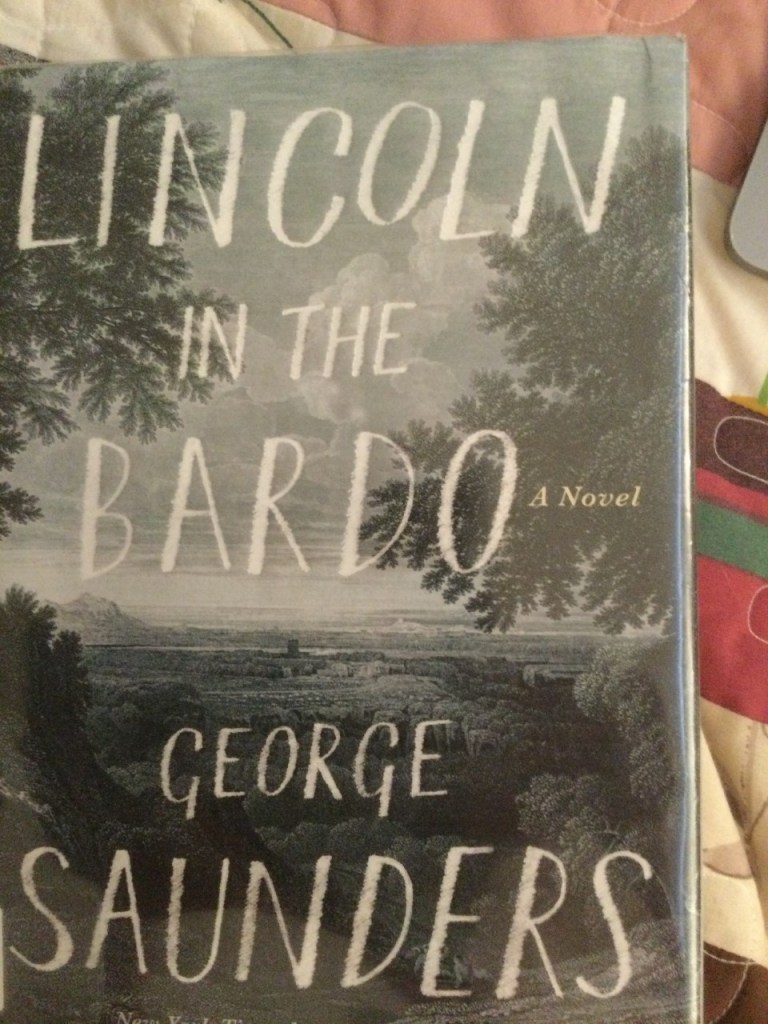
  • This book was published back in 2017, and I have “been meaning to read it” since then. I heard so much about it, not all of it good, BTW. It definitely is different. I finished it the weekend before this one that just passed.

    I checked this out from my local library after my friend, Debbie seemed surprised I hadn’t read it yet.

    The back cover describes the novel as “original, transcendent, and moving,” and it certainly is. The setting, one year into the Civil War, in a graveyard with its (trapped) inhabitants providing a chorus of voices, reminiscent of a Greek chorus in classical plays. Lincoln’s son, Willie, the one most like him and his favorite has died at age eleven. Lincoln’s grief is heroic and utterly devastating. Newspapers of the day report that Lincoln actually did return alone and grieving to the crypt where his son’s body lay, and at one point (at least) took the body from the coffin and cradled it against his own body. There is enough fact and truth in the story, with enough imagination provided by comments of the dead in the cemetery to describe marvelously Lincoln’s emotions and actions against the background of his grief over the splitting of the country of which he was President, and the war that pitted brother against brother.

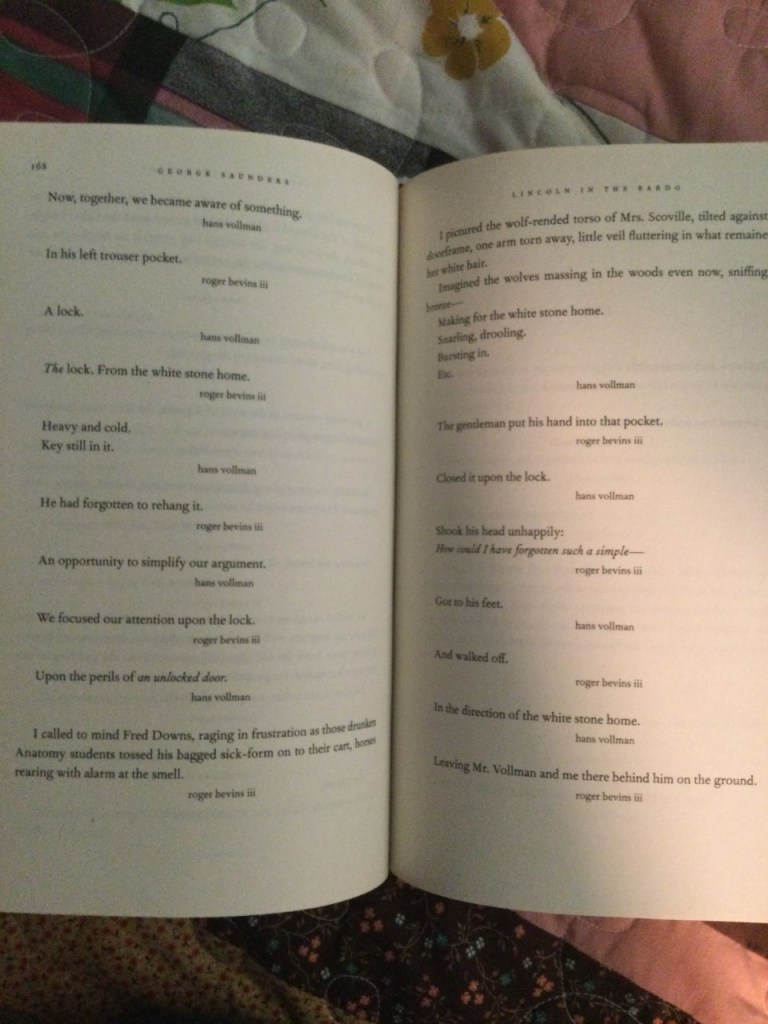
    The format of the book is also very different.

    Pages are divided into quotes, some from historical statements, documents, and journals of the time; others from “quotes” by imaginary residents of the graveyard, who are all rooting for the young child to find peace in the afterlife. (The Bardo is a Tibetan traditional state after death, a kind of purgatory or waiting place. ) They are also aware of the grief and depressed state of the President, for whom they want peace and comfort. Both the format and the theme are highly imaginative/original, presenting a “kaleidoscopic state,” a disorganized tangle of living and dead, historical and invented by the author’s imagination. The philosophical question Saunders poses is, “How can/should we live and love when we know that everything we love must end?”

    SPOILER ALERT–You may wish to skip these last few lines.

    The ending of this emotionally written book is extremely satisfying. We see the boy’s transition into the afterlife and Lincoln’s easing of the great grief and guilt he experienced as he resolves to continue the fighting of the war he believed in so strongly at its inception.

    It turned out to be a “reading experience” for me. I highly recommend it.

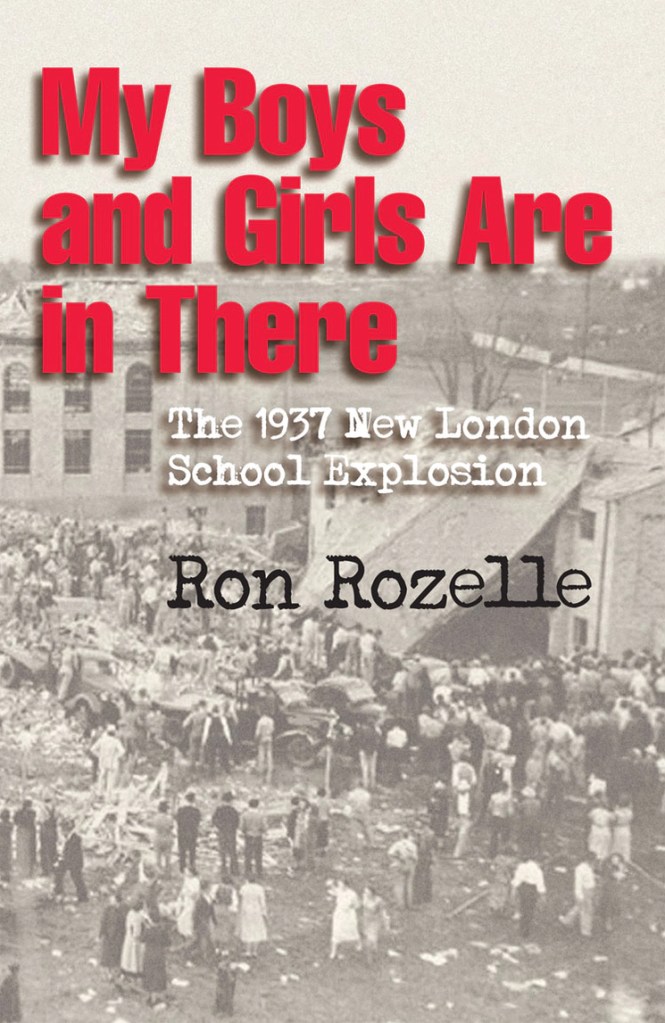
  • Ron Rozelle is a local Texas writer who describes the 1937 New London explosion in New London, Texas. Our Third Tuesday book club had read Suzanne Morris’s Aftermath, which dealt with the on-going effects of the horrendous tragedy afterwards. (For a review use the search box). Rozelle’s book was mentioned at the time, but I didn’t get around to reading it until this past weekend.

    The cover alone speaks of the horror of the explosion.

    I had read another book by Rozelle, a memoir of his father and the father’s death, so I knew he was a good writer. He explains why he wrote the book, “I’ve known about the 1937 explosion all my life.” Rozelle lived only 80 miles away, and his father had gone to help find survivors and casualties, and Rozelle tells us what his father saw that night was so horrible, it prevented his father from speaking of it. Rozelle had been told the cause of the explosion was the superintendent of the school or the school board had tapped into free natural gas, which caused a buildup that exploded. He later learned that was not true, and he wished to clear the superintendent’s name.

    The narrative opens with anecdotes of kids getting ready for school, parents leaving for work, and goes through the day of those individuals until minutes before the last bell of the school day, when the world “turned upside down.” Rozelle deals with the rescue, then the recovery of bodies and identification of body parts, and finally, the aftermath.

    This is non-fiction at its best–carefully researched through interviews and diaries and journals. It is a history that should not be forgotten , and Rozelle has done a beautiful job of seeing that that will not happen.

    One more attempt to read more non-fiction in 2021
    Thank you, Evin.

  • Remembering Twenty Years Ago #neverforget
  • Marcia Meara's avatarThe Write Stuff

    I know this to be a fact! I’d dreamed of being a writer all my life, and finally (at age 69) decided it was time to make that dream come true. Seven novels, three novellas, and a book of poetry later, I’m still going. If I can, YOU can! So dream your dream, then make it a reality! You can do it!

    View original post

  • Carla from Carla Loves Books often participates in this meme, and I have borrowed the picture she uses to feature the books I have acquired for my shelves recently.

    Reading Reality began this meme where one features the books she has added to her TBR/”Read NOW” shelves. Here are some books I have added since last Wednesday:

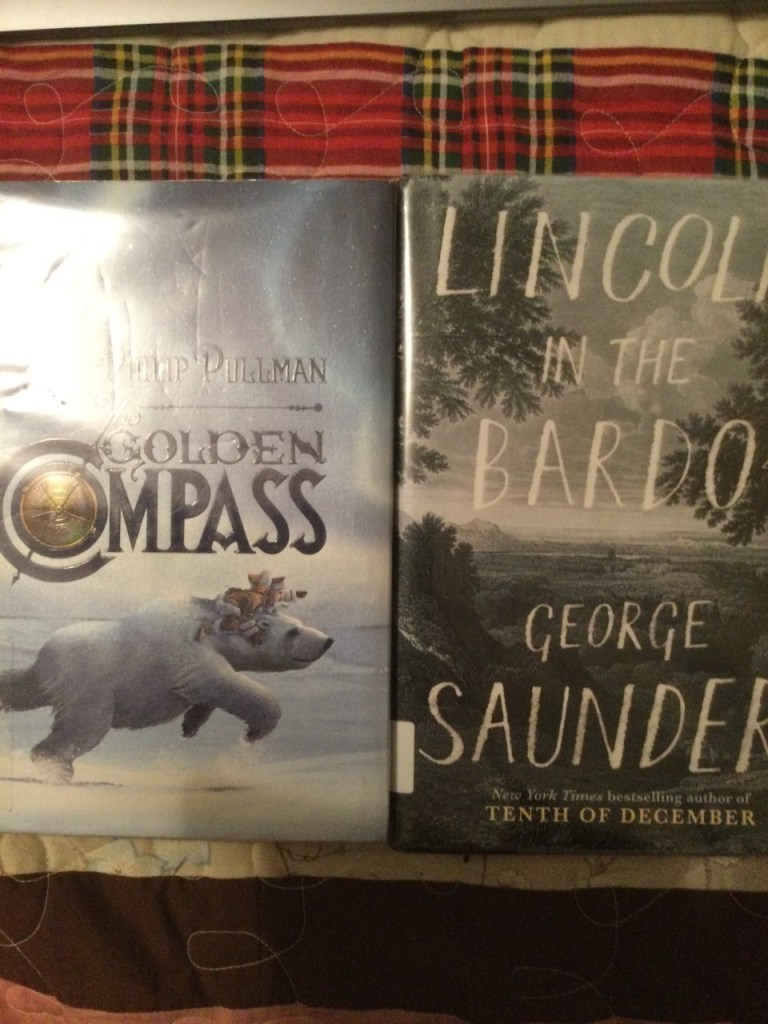
    FROM THE LIBRARY

    I have been wanting to read Saunders’ 2017 novel since it first came out. This weekend I finished it and will review it here on PWR soon.

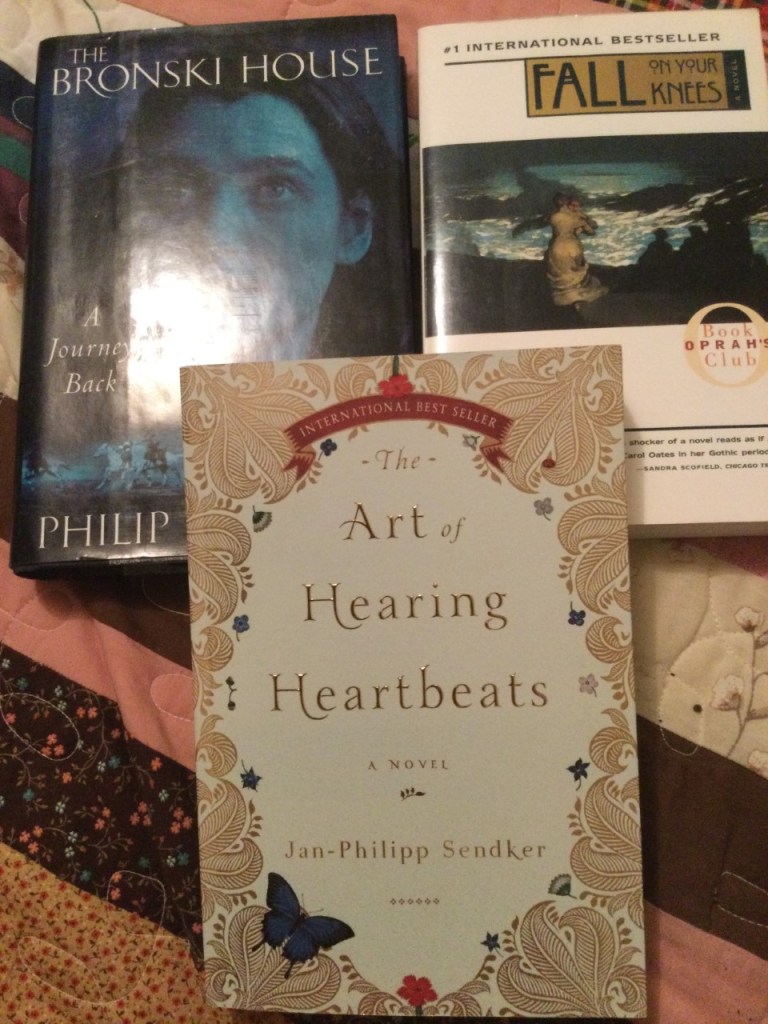
    DONATED TO MY LIITTLE FREE LIBRARY

    One of the perks of maintaining a LFL is that you get first dibs on reading anything that shows up as a donation from someone else. My neighbors have been extremely generous, and I have to add, their reading tastes are excellent. Here are three books that showed up recently. I have only looked over one of them.

    I have begun The Bronski House and am intrigued by the story. However, I have put it aside until I read my other library book. The other two look very promising.

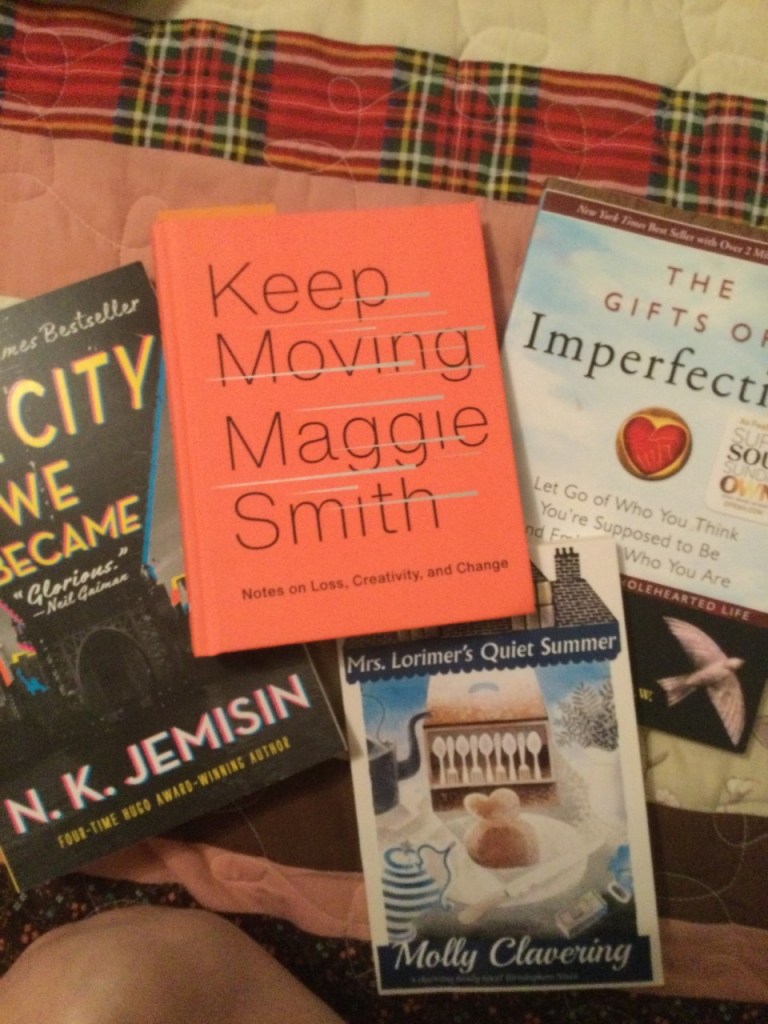
    ARRIVED IN THE MAIL

    I had ordered four books, and they all arrived within days of each other.

    I have made a start on the three on the right, but I’m saving the sci fi from Jemisin for when I have a long sit-down-and-savor block of time to get into it.

    Tonight I began Mary Simses The Rules of Love and Grammar, something I am enjoying so much I am sure I will finish it tomorrow.

    That’s what my shelves look like, and I am very grateful for all the new “starts” toward reading pleasures.

    Thanks, Evin
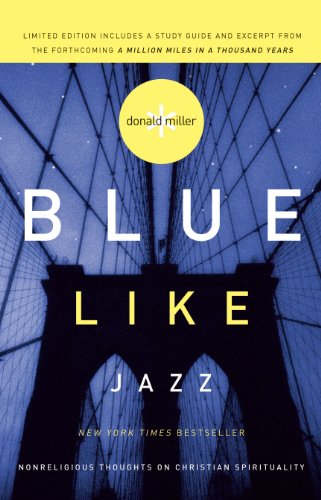
  • Today I finished a book I have been reading all week.
    As part of a goal to read seven inspirational books by December 31st 2021, I arrived today at number four, Blue Like Jazz.

    Earlier, I read Milller’s Searching for God Knows What (reviewed on PWR) During my last trip to Half Price Books, I found this earlier (2003) publication. Jazz’s subtitle is “Nonreligious Thoughts on Christian Spirituality.” The title comes from the author watching a street musician playing the sax and coming to the conclusion, “Sometimes you have to watch someone loving something before you could love it yourself. It is as if they are showing you the way.” The book is part memoir, part inspiration as Miller recounts his experiences on his spiritual journey watching how some of his friends and acquaintances love Jesus.

    Jazz is “for anyone who is still wondering if the Christian faith is still relevant [today].” John Ortberg, another Christian author says, “Miller writes about commitment about God.” Miller states that our Christianity should be like Jazz: “In America, the first generation out of slavery invented jazz music. It comes from the soul, and it is true.” Our love for Christ should be the same. He apologizes for the atrocities done in the name of Christianity and professes to believe in “Christian Spirituality” rather than the organized religion we now call Christianity. There is a big difference, and this short book explains what that is. It is a thought-provoking book that warrants further study.

    Thanks, Evin
  • On PWR Saturday mornings are reserved for book recommendations for kids.

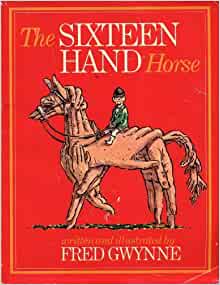
    Today’s title is a fun read as well as a learning experience on literal vs figurative language. The Sixteen Hand Horse, written and illustrated by actor, Fred Gwynne (of The Munsters fame) is today’s selection.

    Obviously a literal translation of figurative language

    The drawings as well as the phrases selected are sure to bring a chuckle to kid and reader alike. When “Daddy’s car has a crack in its block,” the illustration shows the hood of the car open to reveal a broken alphabet children’s block inside. “Daddy says he won’t play cards if the steaks are too high” reveals foot-thick slabs of meat on the card table. These and others like them are fun for parents and grandparents as well as the children in their lives. Lots of pictures; very few words–the book by Fred Gwynne reminds me of his earlier book in the same vein, The King Who Rained, a book I had for sixth graders to peruse during their free time when they’d completed assignments. Many a smile and a share resulted from having that book in my classroom. This one is headed for my Little Free Library now that I have read it. I highly recommend this book.

    This cartoon reminds me of my sixth grade Language Arts students, one of my favorite teaching assignments.
    Another great sign off from Evin.
  • A calming, soothing story full of character development and compassion.

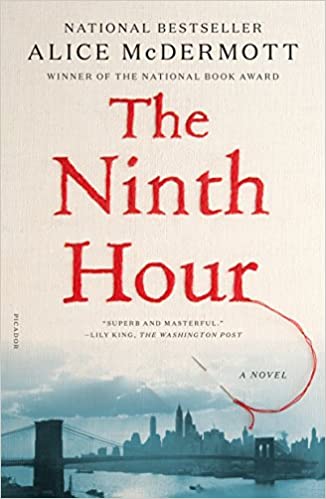
    At first I thought I was not going to like this 2017 publication because it began with a suicide. However, when the Little Nursing Sisters of the Sick Poor arrive and try to cover up the suicide, so the surviving widow can bury her husband in concentrated ground, my interest perked to attention. Set in Catholic Brooklyn in the early 20th century, this novel presents Annie, the pregnant widow and then her daughter, Sally who are taken under the wing of the caring nuns, and follows them through their lives until Sally is old enough to consider taking a vocation. What she decides and why she decided it was a surprise to me, as were many other twists and turns the novel took, right down to the end, where the ending itself was a surprise.

    The Ninth Hour has “quiet power,” one of the characteristics of literary fiction. The novel’s basic themes are “love, sacrifice, and forgiveness.” Sister St.Savior and Sister Jeanne are unforgettable characters who will remain with one long after they have turned the last page. It is definitely a “darned good read.”

    Books can bring comfort as well as diversion from life’s troubles.
    Thanks to my young blogging friend, Evin for the special sign off.